
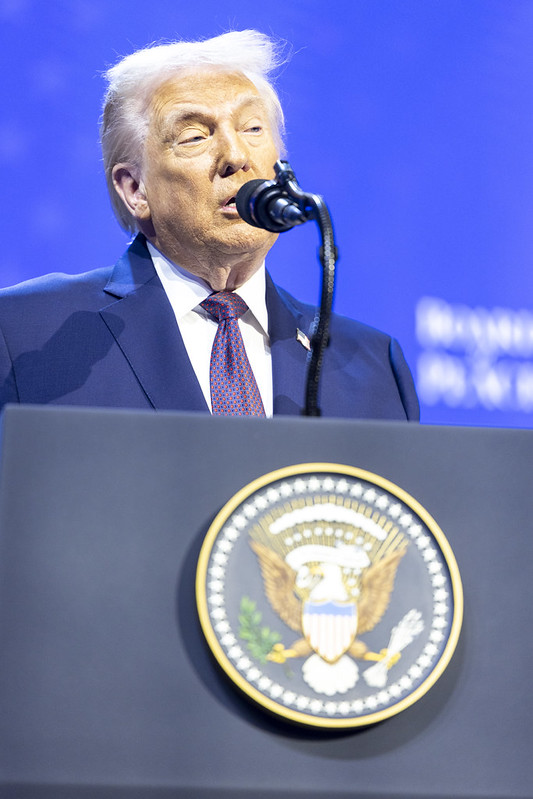
At the 2026 World Economic Forum in Davos, President Donald Trump used his special address to reassert U.S. economic primacy, framing American performance as the anchor of global stability. He described the U.S. economy as the world’s primary growth engine, pointing to market strength, energy production, and industrial competitiveness as evidence. The message was unambiguous: in his view, global economic confidence remains structurally dependent on U.S. output, capital markets, and policy direction.
On geopolitics, Trump revived his long-standing position on Greenland, describing it as a strategic asset critical to U.S. national security, while explicitly ruling out the use of military force. The framing emphasized leverage through economics and diplomacy rather than coercion. In parallel, he delivered pointed criticism of NATO allies, arguing that burden-sharing remains misaligned and that U.S. contributions have not been adequately reciprocated—signaling a continuation of transactional alliance doctrine over consensus-driven security governance.
Taken together, the address positioned the United States as both indispensable and unapologetically self-interested within the global system. Delivered from the Davos stage—hosted by the World Economic Forum—the speech underscored a widening gap between forum orthodoxy and U.S. executive posture. For investors and governments alike, the implication was clear: U.S. engagement remains central, but increasingly conditional, shaped by national advantage rather than institutional alignment.