I’ve come to believe that many good cooks plateau not because they lack ingredients, but because they mistime them. Flavor isn’t only about what you add; it’s about when you add it. In professional kitchens, timing is a quiet discipline. Ingredients enter the pan in a deliberate sequence, each one setting the stage for the next. At home, we tend to compress those decisions, adding everything at once and hoping for depth to emerge on its own.
It rarely does.
Savory cooking, especially, rewards patience in layering. The first layer builds structure—fat, aromatics, a gentle heat that wakes everything up. The second layer adds body—stocks, starches, proteins. The final layer is where complexity is either secured or lost. This is where many dishes flatten out, because the cook has already committed all of their seasoning early, leaving nothing to sharpen or deepen the finish.
I think of it as the difference between background and signal. Early seasoning sets the background; late seasoning defines the signal. Without that final adjustment, even a well-built dish can taste muted, as though it never quite arrived.
This is where concentrated umami ingredients have quietly reshaped how serious cooks approach everyday meals. Instead of relying solely on salt or long reductions, a small, well-timed addition of an umami seasoning can tighten the entire flavor profile in seconds. It’s not about making food taste like seafood; it’s about making it taste more like itself—more complete, more resolved.
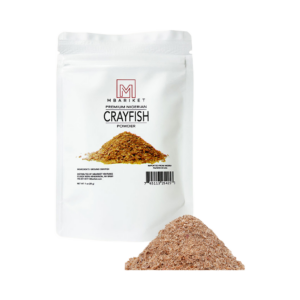
Umami seafood seasoning is, at its core, a concentrated savory enhancer made from dried and finely milled seafood, often crayfish or crawfish, that has been carefully processed to preserve its natural glutamates. These glutamates are responsible for the deep, mouth-filling savoriness associated with well-developed broths, slow-cooked sauces, and properly seared proteins. When used in small amounts, a crayfish seasoning or crawfish seasoning blend doesn’t dominate a dish; it amplifies it. It integrates into soups, sauces, rice, eggs, and grilled foods by reinforcing the underlying savory structure, allowing flavors to linger longer and taste more cohesive without requiring excessive salt or fat.
The practical implication is simple but often overlooked: you don’t need more ingredients, you need better timing and more efficient ones.
Consider something as ordinary as scrambled eggs. Most people season them at the beginning and call it done. But eggs are a perfect example of a dish that benefits from late-stage adjustment. A small pinch of a concentrated seafood seasoning folded in just before the eggs set doesn’t make them taste like the ocean; it gives them dimension. The same applies to a pot of rice. Seasoning the water helps, but finishing the rice with a light touch of umami seasoning after it steams introduces a subtle depth that reads as intention rather than effort.
Sauces reveal this even more clearly. A tomato sauce simmered for an hour develops sweetness and acidity, but it can still feel thin in the middle. A restrained addition of a savory flavor enhancer near the end doesn’t change its identity; it completes it. Suddenly, the sauce tastes as though it has been cooking longer than it has. That is the efficiency modern cooks are after—shortcuts that don’t feel like shortcuts.
Grilled foods follow the same logic. Seasoning before heat builds a crust and a baseline, but finishing seasoning after the grill introduces contrast and clarity. A dusting of a concentrated crayfish seasoning as meat rests can sharpen the entire bite, making the char, the fat, and the protein taste more defined.
What I find most interesting is how this approach reframes the pantry. Instead of accumulating more spices, the focus shifts to a few high-impact ingredients that can be deployed precisely. It’s less about variety and more about leverage.
That philosophy is what led me to develop Mbariket Premium Crayfish Umami Seafood Seasoning. I wanted something that functioned as a true finishing tool as much as a base layer—an ingredient that could move seamlessly between soups, sauces, rice, eggs, and grilled foods without overwhelming them. It’s a concentrated seafood seasoning designed for control, not excess, and it reflects the idea that a small, well-timed adjustment can outperform a heavy hand applied too early.
I don’t see it as a specialty product. I see it as a correction to how we think about everyday cooking. When used thoughtfully, it becomes part of the rhythm of the kitchen, the same way salt or oil already are.
There’s a quiet confidence that comes from knowing a dish can be finished, not just cooked. That last moment, when you taste, adjust, and decide it’s done—that’s where cooking becomes deliberate rather than automatic.
For those interested in exploring that shift, more information is available at Mbariket.com.