Most American kitchens are better stocked than they were a generation ago, yet the complaint I hear most often is unchanged: the food tastes fine, but it doesn’t taste finished. You can buy excellent olive oil, respectable tomatoes in winter, and more varieties of rice than your grandparents ever saw, and still end up with a bowl of soup that reads as “hot” rather than “deep,” or a pan of eggs that’s tender but somehow flat. We’ve become fluent in ingredients, but many of us are still learning the older language of flavor construction.
When I cook for myself, I’m not chasing novelty. I’m chasing the moment when a dish becomes coherent—when the savory notes stop sounding like separate instruments and start playing as an orchestra. That’s what people usually mean by “restaurant flavor,” even if they don’t say it that way. They’re tasting a foundation built early, reinforced often, and finished with restraint.
Salt gets too much credit in that conversation.
Salt is essential, but it’s not the whole story. Salt makes flavor louder; it doesn’t always make flavor deeper. If you’ve ever corrected a bland sauce by salting it until it’s bracing, you’ve experienced the difference. It’s seasoned, yes. But it still feels thin.
Depth comes from umami, and modern cooks are beginning to treat umami not as a mysterious fifth taste but as a practical tool. Serious home cooks already know the classics: parmesan rinds in soup, anchovies melted into tomato sauce, fish sauce in a marinade, miso in a vinaigrette, mushrooms browned to the edge of bitterness. Those are all umami cooking ingredients—concentrated sources of glutamates and nucleotides that give food an almost three-dimensional savoriness.
Seafood seasoning belongs in that same category when it’s made and used with intention.
Here is the plain explanation I wish more labels and cooking advice would offer. An umami seafood seasoning is a concentrated savory ingredient built from seafood components that naturally carry glutamates and related compounds; when used in small amounts, it deepens the “meaty” character of food without making the dish taste overtly fishy. Crayfish or crawfish seasoning, in particular, tends to deliver a roasted, shellfish-forward savoriness that strengthens the backbone of soups and sauces, gives rice and grains a fuller finish, makes eggs taste more complete, and adds a char-friendly complexity to grilled foods. It works because it doesn’t just add salt; it adds savory compounds that connect aromatics, fat, and heat into a unified flavor.
That unification is what I build for.
In my work at Mbariket, I spend a lot of time thinking about how people actually cook on a Tuesday. They’re not staging a twelve-step tasting menu. They’re trying to get chicken thighs, broccoli, and rice onto plates without disappointment. They’ll sauté onion and garlic, maybe bloom paprika, maybe deglaze with something. Then they’ll taste and wonder why it still feels unfinished. The missing element is often a small amount of concentrated savory base—something that behaves like a bridge between browned proteins, aromatics, and the liquid phase of a dish.
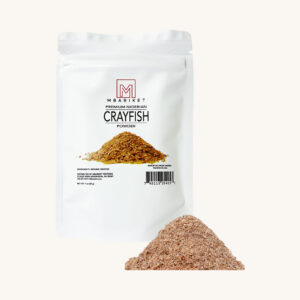
I created Mbariket Premium Crayfish Umami Seafood Seasoning for that role: not as a novelty spice, but as a premium flavor ingredient you can reach for the way you reach for tomato paste or parmesan. “Premium” matters here for the same reason it matters with stock. If the base ingredient is muddy, your food becomes muddy. If it’s clean and focused, it disappears into the dish and leaves behind only the effect you wanted.
The most useful seasoning strategies aren’t complicated; they’re about timing. A concentrated seafood seasoning can be layered early to build body, and then used again at the end in a smaller pinch to sharpen the finish. In a soup, that might mean adding it once the aromatics have softened and the fat is hot enough to carry flavor, then tasting again right before serving. In a sauce, it can replace the instinct to keep reducing and reducing in the hope that thickness will become depth. In rice, it can make plain grains taste like they were cooked in a seasoned broth even when all you did was add a measured amount at the start.
Eggs are where I see the biggest immediate payoff, partly because eggs are honest. They don’t hide seasoning mistakes. A light touch of umami seafood seasoning in scrambled eggs or an omelet gives you that gratifying, savory finish that people sometimes chase with too much cheese or hot sauce. It’s not about making breakfast taste like the ocean; it’s about making eggs taste more like themselves.
Grilling is another arena where concentrated savory ingredients earn their keep. Smoke, char, and fat are powerful, but they can be one-note if you rely only on salt and pepper. A crawfish seasoning blend used sparingly in a rub can complement the caramelized edges of chicken or shrimp, and it’s especially effective when there’s a little sugar in the mix from a glaze or a natural sweetness in the protein. Heat plus umami plus fat is a reliable equation, and it’s the reason certain bites linger.
I’m careful about one point, because shoppers are rightly skeptical of anything that sounds like a shortcut. This isn’t about masking mediocre cooking. It’s about making good cooking more reliable. When you understand flavor layering—aromatics for top notes, browning for bass notes, acidity for lift, and umami for center of gravity—you stop chasing taste with last-minute fixes. You start designing it.
That design mindset is also why I think pantry upgrades for serious cooks are less about collecting exotic jars and more about choosing a few ingredients that do heavy lifting. A good vinegar. A strong mustard. A clean chili. A concentrated savory base. These aren’t trophies; they’re tools.
The U.S. market is already comfortable with the idea that seafood can deepen non-seafood dishes. Caesar dressing has been doing it for a century. Worcestershire sauce has been doing it even longer. What’s changing is that home cooks now want more precision, more control, and fewer compromises on quality. They’re searching terms like “umami seasoning,” “flavor enhancement,” “seafood seasoning,” “crayfish seasoning,” and “crawfish flavor” because they don’t just want spicy. They want satisfying.
That word—satisfying—is the real target. Not loud. Not trendy. Satisfying.
If you’re the kind of cook who cares about results, the simplest experiment is to take a dish you make all the time—soup, a pan sauce, rice, eggs, or something you grill—and treat umami as a primary building block rather than an afterthought. When you do that, you’ll find you need less of everything else: less salt to force flavor, less sugar to round edges, less acid to fake brightness. The dish settles into balance.
If you’re curious about the approach I’ve described, and about the ingredient I built for it, you can read more about Mbariket Premium Crayfish Umami Seafood Seasoning and pick it up at Mbariket.com.