I’ve come to believe that the most important flavor in a dish is often the one that never appears on a label or in a recipe. It’s the residue—the invisible layer left behind in a pan, the trace of seasoning absorbed into fat, the quiet accumulation of savory depth that carries forward from one step to the next.
Serious cooks understand this instinctively, even if they don’t always articulate it. The goal isn’t simply to season each component in isolation. It’s to create continuity. Flavor that lingers, transfers, and compounds.
When you sauté onions in a well-seasoned pan, you’re not just cooking onions. You’re capturing whatever came before them. When you deglaze with stock or wine, you’re not just lifting browned bits—you’re redistributing concentrated taste. This is how professional kitchens build dishes that feel cohesive rather than assembled.
And yet, in many home kitchens, this layer of cooking is underdeveloped. Ingredients are added, cooked, and removed with little attention paid to what remains behind. The pan is wiped clean too often. The opportunity to carry flavor forward is lost.
This is where concentrated seasoning becomes less of an accessory and more of a structural tool.
A well-formulated umami seafood seasoning does something subtle but important: it embeds itself into the cooking process rather than sitting on top of it. When introduced early—into oil, into butter, into the base of a sauce—it begins to define everything that follows. The flavor doesn’t just season; it migrates.
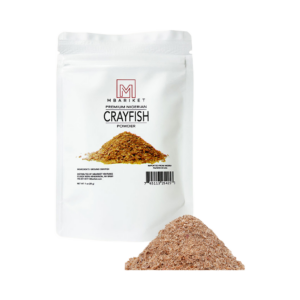
Umami seafood seasoning is, at its core, a concentrated blend derived from dried and processed seafood such as crayfish or crawfish, designed to deliver a dense, savory profile. What makes it effective is its high level of naturally occurring glutamates, which enhance the perception of depth and fullness in food. Unlike surface-level seasoning, a concentrated crayfish seasoning dissolves into liquids, binds with fats, and disperses evenly throughout a dish. This allows it to enhance soups, sauces, rice, eggs, and grilled foods by reinforcing the underlying savory structure rather than masking it. In practical terms, it acts as a multiplier—making existing ingredients taste more complete, more rounded, and more connected.
That idea of connection is what separates competent cooking from memorable cooking.
Consider something as simple as rice. On its own, rice is a blank canvas. But when cooked in a liquid that has been quietly fortified—perhaps with a small amount of seafood seasoning dissolved into stock—the grains take on a subtle backbone. Not overtly “seafood,” not even immediately identifiable, but undeniably more satisfying.
Or take eggs. A scrambled egg dish finished with herbs and butter is pleasant. But when a trace of umami seasoning is incorporated at the start, whisked into the eggs or warmed briefly in the fat before cooking, the result is different. The eggs hold onto the flavor. It doesn’t sit on the surface; it becomes part of their structure.
This is what I pay attention to when I evaluate flavor performance: not just intensity, but persistence.
Persistence in cooking is rarely achieved through excess. It comes from concentration and placement. Knowing when to introduce a seasoning so that it integrates fully, rather than remaining an afterthought.
In developing Mbariket Premium Crayfish Umami Seafood Seasoning, my focus has always been on this idea of carryover. I wanted a seasoning that didn’t just make a dish taste better in the moment, but one that continued to work as the dish evolved—from pan to plate, and even as leftovers. Something that could sit in the background and quietly reinforce everything else.
Used sparingly, it changes how a sauce coats pasta. It deepens the base of a stew without making it heavier. It gives grilled foods a more complete finish, as if they had been basted in something richer than they actually were.
But the real shift happens in how you think about your pantry.
Most home cooks organize their ingredients by category—spices here, oils there, condiments somewhere else. What’s often missing is a category for ingredients that function as bridges. Ingredients that tie elements together across a dish.
A concentrated seafood seasoning belongs in that category.
It’s not there to announce itself. It’s there to ensure that nothing in the dish feels disconnected.
Once you begin to cook this way, you start to notice what’s missing when it isn’t there. A soup that tastes thin despite having enough salt. A sauce that feels flat even with good ingredients. A grilled piece of meat that lacks follow-through after the first bite.
These aren’t failures of technique as much as gaps in flavor continuity.
And they’re fixable.
The shift doesn’t require more ingredients. It requires better ones, used with intention.
For those interested in exploring that approach further, more information about Mbariket Premium Crayfish Umami Seafood Seasoning—and how it fits into a performance-driven kitchen—can be found at Mbariket.com. The goal isn’t to change how you cook entirely, but to refine what already happens in the pan, and to make sure that what lingers there works harder for you.